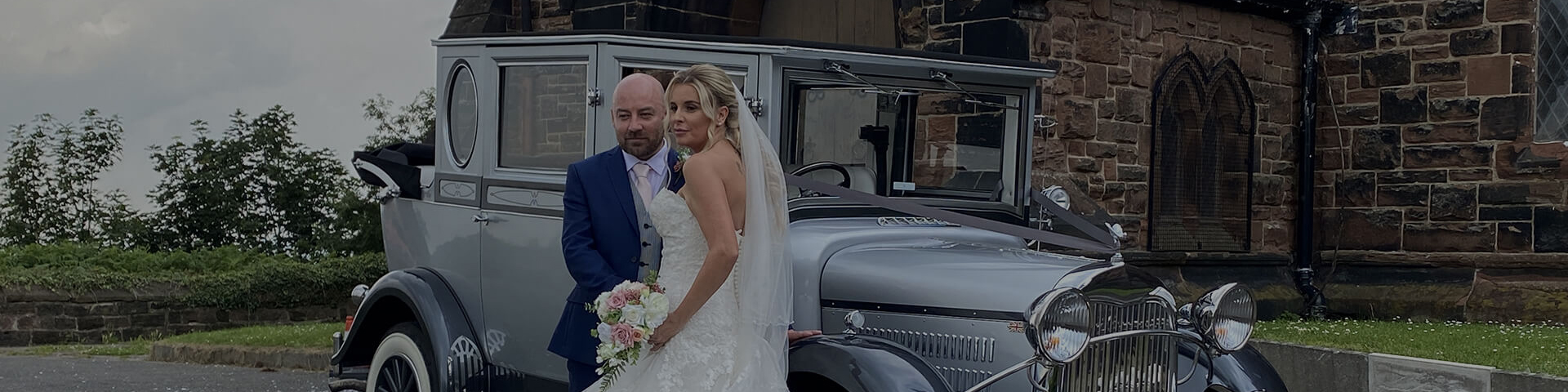
Best Wedding Cars for a UK Wedding
Caroline Lamont - 7th September 2026
The best wedding car is not simply the most expensive or dramatic vehicle. It is the car that fits your wedding style, carries the right people comfortably, suits the route and gives you the arrival and photographs you actually want.
Direct Answer: What Are the Best Wedding Cars for a UK Wedding?
For traditional weddings, vintage landaulettes and classic luxury cars remain strong choices because they create a formal arrival and photograph beautifully. For contemporary weddings, modern luxury cars such as the Mercedes S Class offer comfort, clean styling and a refined journey. For larger wedding parties, a seven-seat vehicle can be more practical than booking several smaller cars.
The best choice depends on six things: the number of passengers, the wedding dress, the route, the venue, the photographs and the atmosphere you want. Start with the job the car must do, then choose the style.
£593Average UK wedding-transport spend reported by Bridebook in July 2026.
3 hrsApproximate traditional hire period Bridebook describes for ceremony, photos and reception travel.
9–12 moBridebook's 2026 general booking guide for peak-season wedding cars.
Data context: the figures above are national planning benchmarks from Bridebook's July 2026 UK wedding transport guidance. They are not Lamont Wedding Cars prices or booking rules; actual availability, timing and quotes depend on your date and itinerary.
Start With Your Wedding, Not With a Car Badge
A wedding car is part transport, part styling and part photography prop. That combination is why two couples with similar budgets can make completely different choices and both be right. A vintage car can feel perfect outside a church, country house or historic venue. A modern luxury saloon can look sharper outside a contemporary hotel or city venue. A larger seven-seater can solve a practical problem that neither of those choices addresses on its own.
Look through the Lamont wedding car collection first, but do it with your actual passenger plan and route in mind rather than choosing on appearance alone.
The Main Wedding Car Types Compared
| Wedding car type | Best suited to | Main strengths | Check before booking |
|---|
| Vintage landaulette | Traditional, romantic, church and country-house weddings | High visual impact, generous rear space, distinctive photographs | Passenger capacity, door width, roof arrangement and route suitability |
| Vintage convertible | Couples who want period style with open-roof photo potential | Flexible look in suitable weather and a strong arrival moment | Weather plan and how quickly the roof configuration can be changed |
| Modern luxury saloon | Contemporary venues, city weddings and longer journeys | Refinement, quiet cabin, climate control and discreet elegance | Rear-seat space with the wedding outfit and ease of entry |
| Luxury people carrier | Bridesmaids, family groups and larger wedding parties | More passengers in one vehicle and easier group coordination | Seat layout, luggage, dresses and whether everyone must arrive together |
| Electric luxury car | Modern weddings and couples who like minimalist technology-led design | Smooth, quiet travel and contemporary photography | Exact model, passenger comfort and route requirements |
Best Wedding Car for a Traditional Wedding
For a formal church wedding, stately-home reception or classic hotel, a vintage or period-style car usually feels visually coherent. The shape, upright cabin and traditional detailing create a clear sense of occasion before the passenger even steps out. It also gives the photographer an obvious visual feature to use in arrival, departure and couple portraits.
Lamont's vintage fleet includes the Regent Landaulette, Regent Convertible and Imperial Landaulette. The website describes six- and seven-seat options, wide-opening doors and generous rear space. Those details matter because a car can look beautiful in a photograph yet still be awkward if the doorway is narrow or the rear cabin is cramped around a full skirt, train or multiple passengers.
Choose the Doorway as Carefully as the Bodywork
Before booking a vintage wedding car, picture the moment of getting in and out while wearing the actual outfit. A wide door opening, sensible seat height and enough room to turn can be more valuable than a small difference in styling. If your dress has a structured skirt, long train or delicate embellishment, viewing the car in person can remove uncertainty.
Best Wedding Car for a Modern Wedding
A modern luxury car suits couples who want the journey to feel calm, polished and contemporary. This is particularly useful for city-centre venues, modern hotels, converted industrial spaces and weddings where the styling is clean rather than ornate. The car becomes part of the overall design without dominating it.
Lamont lists the Mercedes S Class, Mercedes V Class and Tesla Model S among its modern choices. The S Class offers a traditional luxury-saloon silhouette, the V Class provides substantially more passenger capacity, and the Tesla creates a different modern aesthetic. Which is “best” depends on whether the priority is the couple's arrival, moving a group or creating a particular look.
Best Wedding Car for a Large Dress
Prioritise space
- Wide-opening rear doors.
- Enough floor space to gather the dress without forcing it under feet.
- Rear-seat width that allows the skirt to spread naturally.
- A sensible step-in height for heels and formalwear.
- Room for a parent or companion without crushing the outfit.
Do not assume size from photos
- Exterior length does not guarantee a spacious rear cabin.
- Low sports-style cars can be harder to enter gracefully.
- Thick door frames can reduce the usable opening.
- Fixed centre consoles can affect how a dress sits.
- Roof height matters if the outfit includes a veil or headpiece.
Best Wedding Car for Bridesmaids and Family
If several people need to leave the same address and arrive before the main wedding car, capacity can be more important than prestige. One suitable multi-seat vehicle may be easier to coordinate than splitting the group across several unrelated cars. It also reduces the risk that one group gets caught at a different set of traffic lights or takes a different route.
A seven-seat Imperial Landaulette or Mercedes V Class can be useful where the group size and route allow it. The important calculation is not simply “how many bridesmaids do we have?” but “how many people must travel at the same time, from the same place, with formalwear and any items they need to carry?”
Best Wedding Car for Photographs
Photography is one of the strongest reasons to choose a distinctive wedding car. Vintage cars create curves, chrome, large wheels and period details that can frame the couple. Modern cars create cleaner lines and a more editorial feel. Neither is automatically more photogenic; the better option is the one that complements the venue and the visual tone of the wedding.
Historic venueLet period detail reinforce the setting
Stone churches, manor houses and traditional hotels often work naturally with vintage bodywork and formal chauffeur styling.
City venueKeep the lines clean
Modern luxury cars can suit glass, steel, city streets and contemporary hotels without making the photographs visually busy.
CountrysideThink about access as well as scenery
A dramatic rural setting is useful only if the route, turning space and parking area are sensible for the chosen vehicle.
Best Wedding Car for a Long Journey
If the collection point is a long distance from the ceremony, comfort becomes a much bigger factor. You may spend enough time in the car for cabin temperature, suspension, seat position and noise level to affect how relaxed you feel when you arrive. Modern luxury cars are often strong for longer routes because they are designed around refinement and climate-controlled comfort.
A vintage car can still be the right choice, but the route should be discussed honestly. Fast roads, very long distances, steep access roads or tight city-centre sections may influence which vehicle is the most sensible. A specialist supplier should plan the vehicle around the real itinerary rather than treating every route as interchangeable.
Best Wedding Car for a Summer Wedding
Summer creates two competing needs: you may want open-roof photographs, but you also need a realistic plan for heat, sudden rain and direct sun. A convertible or landaulette can create exceptional images when conditions are right, but the roof should be treated as an option rather than a promise that dictates the whole schedule.
Do Not Build the Day Around Perfect Weather
Choose a car you will still enjoy with the roof up. A UK wedding plan needs to work in bright sun, wind or rain. The photographer can adapt positions and angles; the transport plan should remain reliable regardless of conditions.
Best Wedding Car for an Autumn or Winter Wedding
For cooler months, the practical priorities shift toward cabin comfort, covered entry and a schedule that does not depend on outdoor photographs. A modern luxury car can be appealing for warmth and refinement, while a vintage car can look especially striking against autumn colours, winter venues and darker formal styling.
The date also affects daylight. If photographs with the car are important, work backwards from the likely light level rather than assuming the portrait session can happen at the same point in the schedule as a summer wedding.
Should Your Wedding Car Match Your Colour Scheme?
It does not need to match literally. A car is a large visual object, so neutral finishes often work well because ribbons and flowers can provide the smaller colour accents. The stronger question is whether the car clashes with the overall look. A silver, ivory or two-tone vintage car can sit comfortably with many palettes; a clean modern silver car can be equally flexible.
If you want ribbons in a particular colour, ask how that shade appears against the actual paintwork. Lamont states that couples can choose ribbon colour, which gives you a way to connect the vehicle with the wedding styling without turning the car itself into a theme prop.
One Statement Car or Matching Cars?
| Approach | Advantages | When it works best |
|---|
| One statement car | Focuses budget and photography on the main arrival; simpler coordination. | Small wedding parties, single pickup point, simple itinerary. |
| Two matching cars | Creates a coordinated procession and allows simultaneous or closely timed movements. | Bridal party plus main couple, separate passenger groups, formal weddings. |
| Vintage + modern combination | Allows different jobs to be solved by different vehicle types. | Main couple wants vintage style while a larger group needs modern capacity. |
| One high-capacity vehicle | Can keep a group together and reduce duplicated journeys. | Passengers start together and the timings do not overlap. |
How to Match the Car to the Venue
- Check entrance width and turning space.
- Ask where the wedding car is allowed to stop.
- Find out whether the photographer can position the car in front of the venue.
- Check gravel, steep ramps or narrow lanes.
- Confirm city-centre loading restrictions where relevant.
- Ask whether the venue has a preferred arrival route.
- Consider what will be behind the car in photographs.
- Think about where the car waits during the ceremony.
- Check whether guests will block the main arrival area.
- Plan a wet-weather exit from the vehicle.
What Makes a Wedding Car Feel Special?
The car itself matters, but the service surrounding it matters just as much. Timing, presentation, a chauffeur who understands wedding-day pace, help with doors and dresses, and the willingness to work with the photographer all influence the experience. A prestigious model without reliable service is not the best wedding car.
Lamont Wedding Cars describes a one-wedding-a-day approach, professional drivers and more than 1,000 weddings completed. Those operational details matter because a wedding car is attached to a fixed ceremony time rather than a flexible leisure journey.
How Much Should the Best Wedding Car Cost?
There is no single figure because the car, route, date and duration all matter. Bridebook's July 2026 guide gives rough national ranges of £400–£800 for a classic wedding car for around three hours and £300–£700 for a modern luxury car. Its separate cost guide reports an average UK wedding-transport spend of £593.
Use those figures as context, not as a target. A quote that includes the right vehicle, all required journeys, waiting time and a well-planned schedule can be better value than a lower number that leaves important parts of the day unclear.
Best Does Not Mean Most Expensive
A car can be “best” because it reduces the number of vehicles you need, gives you easier access in a large dress, fits the venue better or keeps a nervous passenger comfortable. Value comes from solving the whole wedding transport problem, not winning a badge comparison.
A Practical Wedding Car Scoring Method
| Factor | Score out of 5 | What a high score means |
|---|
| Appearance | /5 | You genuinely love how the car looks with your venue and wedding style. |
| Passenger fit | /5 | Everyone who needs the car can travel comfortably without awkward shuttles. |
| Dress access | /5 | Doors, seat height and cabin space work with formal clothing. |
| Route suitability | /5 | The vehicle suits the distance, road type and venue access. |
| Photography | /5 | The car adds something useful to your planned photographs. |
| Service confidence | /5 | You understand the itinerary, timing, inclusions and contingency plan. |
A car that scores strongly across all six categories is usually a better choice than one that gets 5/5 for appearance but creates problems everywhere else.
Questions to Ask Before Choosing Your Final Car
- What is the exact passenger capacity?
- Can we view the car before booking?
- Will our dress and formalwear fit comfortably?
- Does the vehicle suit our complete route?
- How long is the car available to us?
- Can we use the car for photographs?
- What happens if the weather changes?
- Are ribbons included and can we choose the colour?
- Is the chauffeur service included?
- What is the plan for reasonable delays?
- What happens if the booked vehicle develops a problem?
- Do you need final timings by a particular date?
Why Experience Matters More Than a Long Fleet List
A huge list of vehicles can look impressive, but weddings are time-critical. What matters is whether the supplier knows how to plan pickups, allow sensible buffers, position the car, work around formal clothing and communicate clearly. You can read more about Lamont's family-run wedding car service, which explains the company's local experience and wedding-focused approach.
Final Verdict: Which Wedding Car Is Best?
The best wedding car is the one that looks right, fits comfortably and makes the schedule easier rather than harder. Choose vintage when period character, generous rear space and photography are central to your vision. Choose modern luxury when refinement, contemporary styling and longer-distance comfort matter. Choose a higher-capacity vehicle when moving the wedding party efficiently is the real problem to solve.
If you want help comparing specific cars against your passenger numbers and route, contact Caroline at Lamont Wedding Cars. For more planning guides covering timing, numbers of cars and booking decisions, see the Lamont Wedding Cars blog.
A wedding car should earn its place in the day three times over: it should transport you properly, make the arrival feel special and give you photographs you are happy to keep.